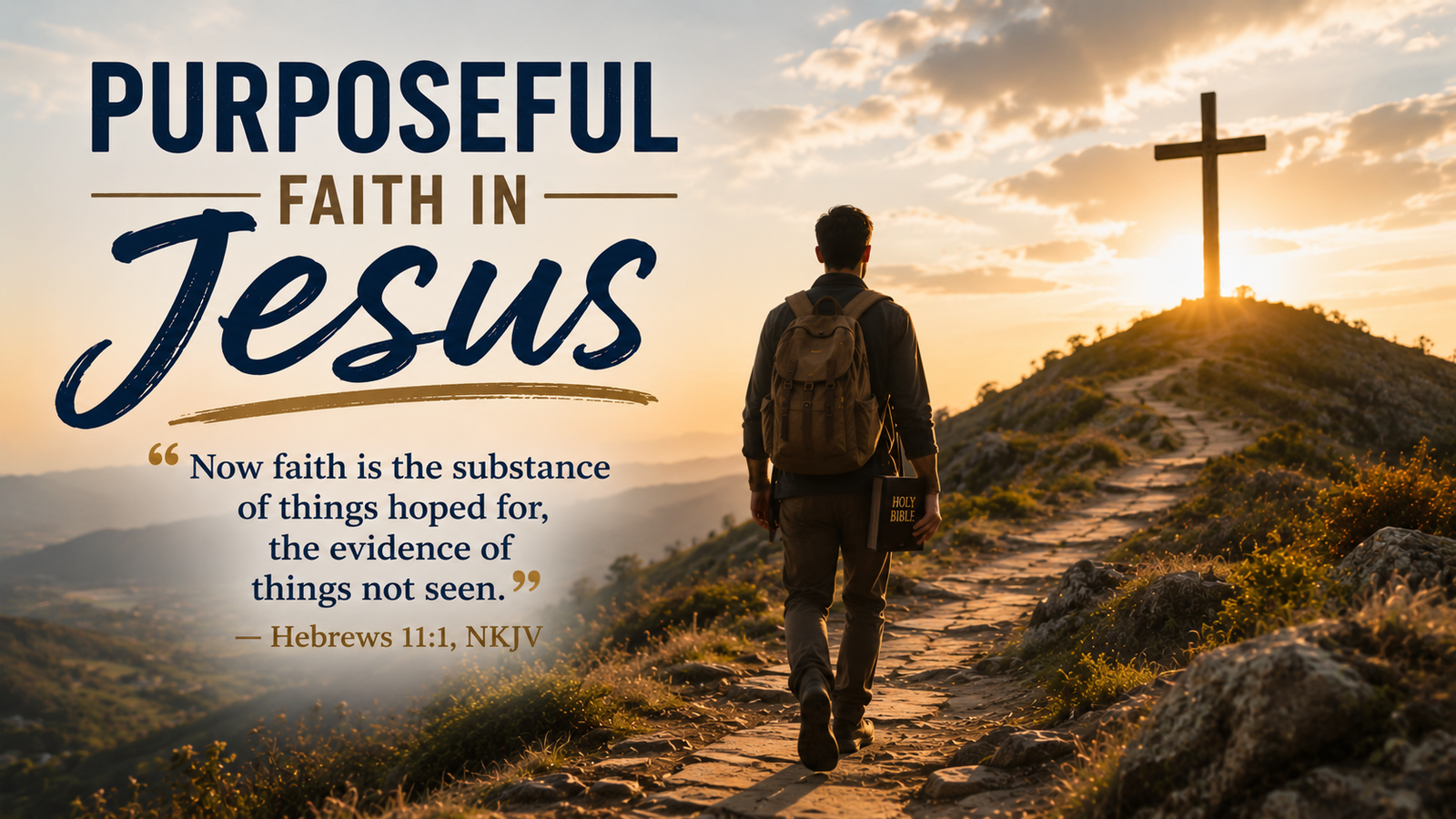
Purposeful Faith in Jesus
“Now faith is the substance of things hoped for, the evidence of things not seen.” — Hebrews 11:1, NKJV
You know the step you need to take. You have known it for a while. You can feel it — the pull of what God is asking you to move toward. But you are still standing in the same place, because you cannot see where it leads. You have prayed about it. You have thought about it. You have had the conversations. And still no map has appeared, no guarantee has arrived, no confirmation clear enough to make the risk feel safe.
So you wait for more information before you move. Here is what is worth naming honestly about that kind of waiting: it often has nothing to do with needing more information, and everything to do with needing more certainty than faith actually requires. We want to be sure the step will work out before we take it. We want to see the outcome before we commit to the process. And because God rarely provides that level of certainty in advance, the step never gets taken — and we mistake the waiting for wisdom when it is actually fear wearing a patient face.
Purposeful faith is not recklessness dressed up in spiritual language. But it is also not waiting until you can see the whole road. It is taking the next step because you know and trust the One who holds it.
Faith Is Not Blind — It Is Anchored
Hebrews 11:1 uses two words that are easy to read past: substance and evidence. These are not emotional or feeling-based words. Substance refers to a real foundation — something with actual weight that can be stood on. Evidence is the word used for legal proof — the kind that holds up under scrutiny. The author of Hebrews is making a deliberate argument: faith is not the absence of reason. It is the application of what you already know about God to what you cannot yet see.
This distinction matters because it removes a common excuse for staying in place. We often tell ourselves that we cannot act because we do not have enough information. But Hebrews 11:1 reframes the question entirely: the information faith requires is not a map of what comes next. It is a settled knowledge of who is asking you to move. Purposeful faith in Jesus does not ask you to ignore reality or pretend uncertainty does not exist. It asks you to place your knowledge of who Jesus is above your current inability to see the outcome. You may not know where the step leads. You know who is asking you to take it. That is the only information faith actually requires.
When the Risk Feels Too Great
Fear of failure is one of the most common reasons people with genuine faith stay in place. Psychologists call this risk aversion — the tendency to prefer a certain but smaller outcome over an uncertain but larger one, even when the uncertain option is objectively better in the long run. In practical terms, it means we would rather accept the known discomfort of staying exactly where we are than risk the unknown discomfort of moving toward where God is calling. Both choices carry a cost. The difference is only in where the discomfort lives: in the going, or in the staying. Most people who remain stuck are not lacking faith in God. They are weighing the cost of movement against the cost of stillness — and choosing stillness because it feels like the safer loss.
Abraham: He Went Without Knowing
Hebrews 11 is sometimes called the Hall of Faith — a record of men and women who acted on what God said before they could see how it would turn out. At the center of that list is Abraham, and the way his obedience is described in a single verse is one of the most straightforward summaries of what active faith looks like in practice:
“By faith Abraham obeyed when he was called to go out to the place which he would receive as an inheritance. And he went out, not knowing where he was going.” — Hebrews 11:8, NKJV
Not knowing where he was going. That detail is not included to make the story dramatic. It is the actual condition under which Abraham moved. He did not have a map. He did not have a timeline. He did not have a guarantee that the journey would end well by any standard he could measure in advance. He had a word from God and a relationship with the God who spoke it. And on that basis, he packed his household and left Ur — one of the most prosperous and established cities in the ancient world — and walked toward a promise he would not see fully fulfilled in his own lifetime.
Abraham did not go because the risk was small. He went because his knowledge of God was greater than his fear of the unknown. And that knowledge was not theoretical. It had been built through real encounters, real conversations, and real moments when God had shown Himself faithful. Abraham had a history with God — and that history had created a foundation solid enough to walk on even when the road ahead was invisible.
This is the part that changes how we read the story: purposeful faith is never built in a single moment of courage. It is built through accumulated trust, one encounter at a time, until the moment of obedience arrives and there is something solid already underneath you. What Abraham modeled was not a personality trait or a spiritual gift available only to exceptional people. It was the logical outcome of a close relationship with a trustworthy God. The closer you are to Him, the more evidence you carry of His character. The more evidence you carry, the more reason you have to move when He calls. The step is not a leap into nothing. It is a step onto ground that His faithfulness has already prepared.
Pause & Reflect
Take your time here. These questions are meant to bring you to a specific place, not a general one. Do not answer them quickly.
1. What do you notice about how Hebrews 11:8 describes Abraham’s obedience? The verse does not say he went confidently or without fear — it says he went not knowing where he was going. What does it mean that his faith is defined not by what he could see, but by the fact that he moved anyway?
2. What is the step you have been delaying — the one you already know God is asking you to take? Be honest about what has been keeping you in place. Is it actually missing information you do not have, or is it the desire for a level of certainty that faith does not require?
3. Write down three things you know to be true about God’s character based on your own history with Him — specific moments, not general beliefs. How does what you already know about Him apply to the step that is in front of you right now?
Walking It Out This Week
Take the first inch of the step you have been delaying. Not the whole journey — one small, concrete, real movement in the direction God has been pointing. Write down exactly what that looks like in practical terms. Then do it before the week is over. Faith that lives only in your thoughts is not yet faith in the biblical sense. It becomes faith when your feet follow your belief. The first inch is the hardest one. Take it.
Build your case from your history with God. Before you act, set aside thirty minutes to write down the moments in your life when God came through — when something happened that you cannot explain apart from His faithfulness. Read it back to yourself slowly. You are not building confidence in your own ability to handle what comes next. You are building confidence in His track record. Abraham had that history. You have yours. Use it.
Stop waiting for the certainty that faith does not require. God rarely shows the whole road before asking you to move. What He shows is the next step — and who He is. That combination has always been enough for the people listed in Hebrews 11. It is not that they had fewer fears or fewer unknowns than you do. It is that they had decided their knowledge of God outweighed their uncertainty about outcomes. You can make the same decision. Not because the risk disappears, but because the One sending you is greater than the risk.
Prayer
Lord, I know the step. I have known it for a while. And I have been honest with myself this week about what has been keeping me in place — it is not that I need more information. It is that I am afraid of what happens if I move and it does not go the way I hoped. I want a guarantee before I go. And You have not given me one.
But I know You. Not perfectly, and not without questions — but I know enough. I know You have not failed me when I trusted You before. I know Your character. I know You are good. And I know that faith built on You is not the same as a guess — it is a step taken on the most reliable ground that exists.
Give me the courage to take the first step — not because I can see the end, but because I trust You enough to move. I do not have to know where I am going. I just have to know who is leading. I choose to go. In Jesus’ name. Amen.
Abraham did not go because he could see the destination — he went because he knew the God who was sending him, and that has always been enough.