Day 3: The Strength of the Anchor
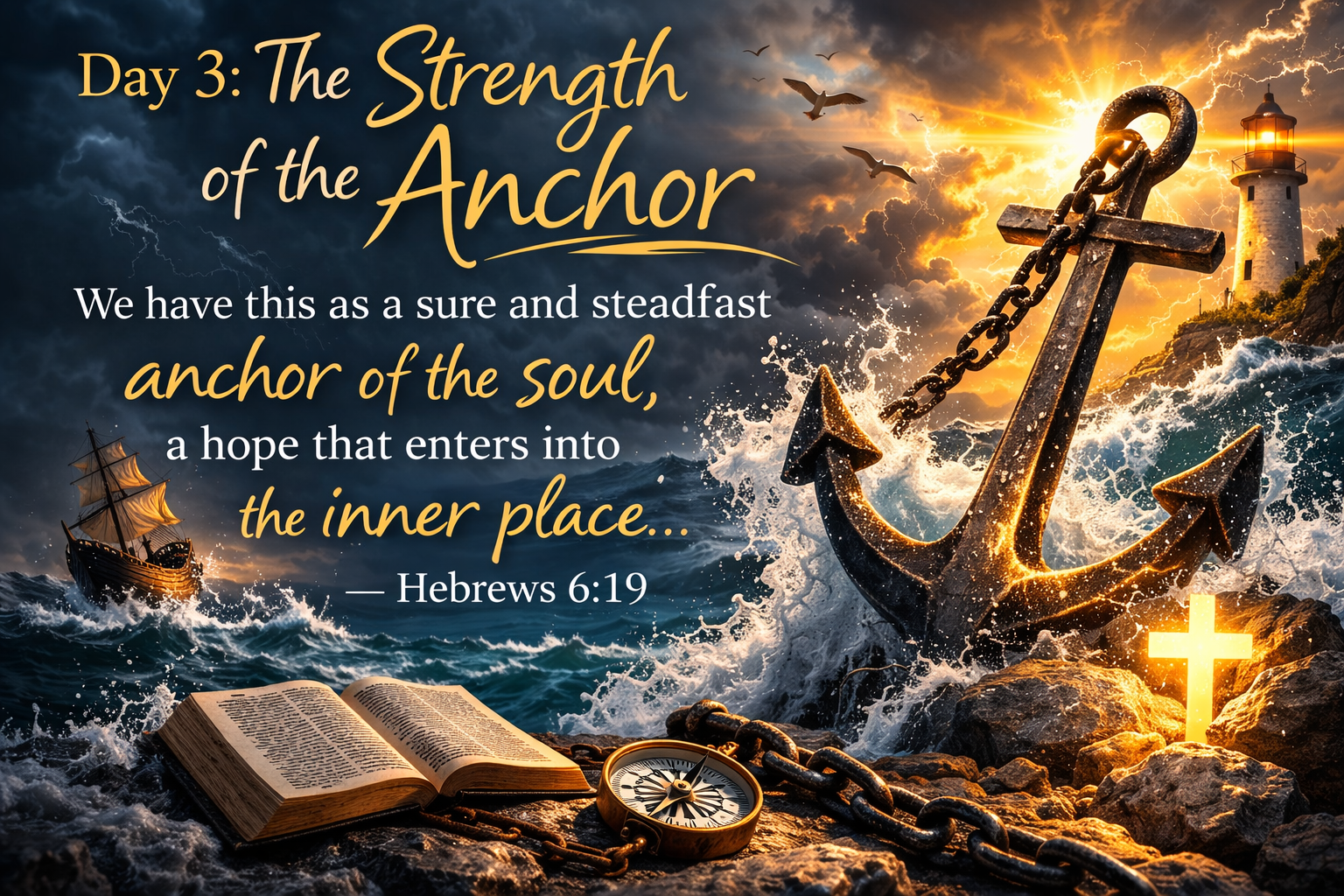
“We have this as a sure and steadfast anchor of the soul, a hope that enters into the inner place behind the curtain.” — Hebrews 6:19, (ESV)
There are moments when everything around you feels like it is shifting. The plan you counted on falls through. The relationship you leaned on starts to feel shaky. The version of life you expected slowly looks different from what is actually in front of you. In those moments, most people do not panic right away — they reach. They reach for whatever is nearest and feels solid.
Maybe that looks like throwing yourself deeper into work. Maybe it is refreshing your bank account balance more than once a day. Maybe it is checking to see if certain people still approve of you. These things feel like anchors because for a while — they hold. But here is what no one tells you until the storm comes: not everything that feels like an anchor actually grips the ground.
So the real question worth asking today is not whether you have an anchor. The question is what your anchor is actually hooked into.
A Hope That Goes Deeper Than the Surface
Hebrews 6:19 does not describe hope as a feeling. It describes hope as a physical force — an anchor. And an anchor is not about how shiny the metal looks or how heavy it feels when you hold it. An anchor does one job: it drops below the surface and connects to something that does not move.
The writer of Hebrews says our hope enters “the inner place behind the curtain” — a reference to the holy of holies in the Old Testament temple, the place where God’s presence rested. In other words, the anchor of your soul is not dropped into your career or your reputation or your savings. It is dropped into the eternal presence of God Himself. That is what makes it sure. That is what makes it steadfast. Not because your circumstances are calm, but because what your hope is hooked into never moves.
When the Things We Lean On Begin to Slip
The problem is not that people want stability. The problem is that we often look for it in places that feel permanent but are not. Psychologists call this contingent self-worth — the habit of tying your sense of security to things that can be taken away. Your identity gets wrapped around your job title, and then there is a layoff. Your peace gets tied to a relationship, and then that relationship changes. Your confidence gets built on a dream, and then the dream stalls. When those things shake, something deeper shakes with them — and that is not weakness. That is what happens when an anchor is hooked into sand instead of rock.
What the Anchor Actually Connects To
The book of Hebrews was written to a group of Jewish Christians who were exhausted. They had believed, and it had cost them. Some had lost property. Some had been publicly humiliated. Some were wondering if walking away from their old faith had been a mistake, because at least back then, things had felt more stable — or at least more familiar. The author of Hebrews writes to people on the edge of drifting. And what he does not say is, “Try harder.” He does not say, “Stay positive.” He points them to something they cannot earn and cannot lose.
“We have this as a sure and steadfast anchor of the soul, a hope that enters into the inner place behind the curtain.” — Hebrews 6:19, ESV
The Greek word translated “sure” here is asphalē — it means something that cannot slip. The word “steadfast” carries the idea of something immovable, weight-bearing. This is not poetic language. The writer is making a claim: the hope we have in Jesus Christ is the only thing in existence that cannot be destabilized by what happens around it.
And the anchor does not hook into a feeling of peace or a strong quiet time or a season when life is going well. It hooks into the finished work of Jesus — His life, His death, His resurrection — and into the eternal presence of the Father. These things existed before your worst week. They will exist after it. When your storms rise, the anchor does not re-evaluate. It holds.
Pause & Reflect
Take a few honest moments with these questions before moving on.
1. When you look at Hebrews 6:19 and the image of an anchor that drops into God’s very presence — what surprises you about that picture? What does it say about what hope is actually meant to do?
2. Think about the last time something in your life felt shaky — work, a relationship, a plan. What did you reach for first to steady yourself? What does that reveal about where your anchor tends to drop?
3. What would it look like this week to actively place one specific worry into God’s hands — not just once, but every time it comes back? What is one thing you keep picking back up that you are being invited to release?
Walking It Out
Start with something specific. Do not try to surrender everything at once — that usually ends in surrendering nothing. Instead, identify one situation that has been pulling at your peace this week. Write it down. Name it plainly. Then bring it to God in prayer — not a polished prayer, but an honest one. Something like: “Lord, I keep carrying this. I know You are steadfast even when I am not. I choose to place this in Your hands today.” That act of honest release is not weakness. It is the anchor dropping.
Second, practice re-anchoring when the worry returns. It will return — that is not a failure of faith. When it does, instead of following the spiral, say one simple truth out loud or in your mind: “My hope is anchored in Christ.” Not as a chant, but as a real reminder of what is true beneath the surface of what you are feeling.
Third, begin paying attention to what you reach for when things feel uncertain. Not to shame yourself for it, but to notice the pattern. Awareness is the first step toward choosing differently. Every time you notice yourself reaching for a temporary anchor — approval, control, distraction — you have an opportunity to redirect. The anchor of Christ is available in that very moment. Drop it there.
Prayer
Jesus, I am honest with You right now about how unsettled some things feel. There are worries I keep picking back up even after I say I am laying them down. There are places in my life where I have been reaching for stability in things that shift — and I can feel the drift.
Today I am choosing to drop my anchor in You — not because I feel peaceful, but because You are the only thing that does not move. I place the worry I have been carrying into Your hands. I release the need to control what I cannot control. Hold me in Your presence and remind me, when I start to drift, that my hope is already secured in something that cannot slip.
In Jesus’ name. Amen.
The storm does not have the final word — the anchor does, and it is already holding.