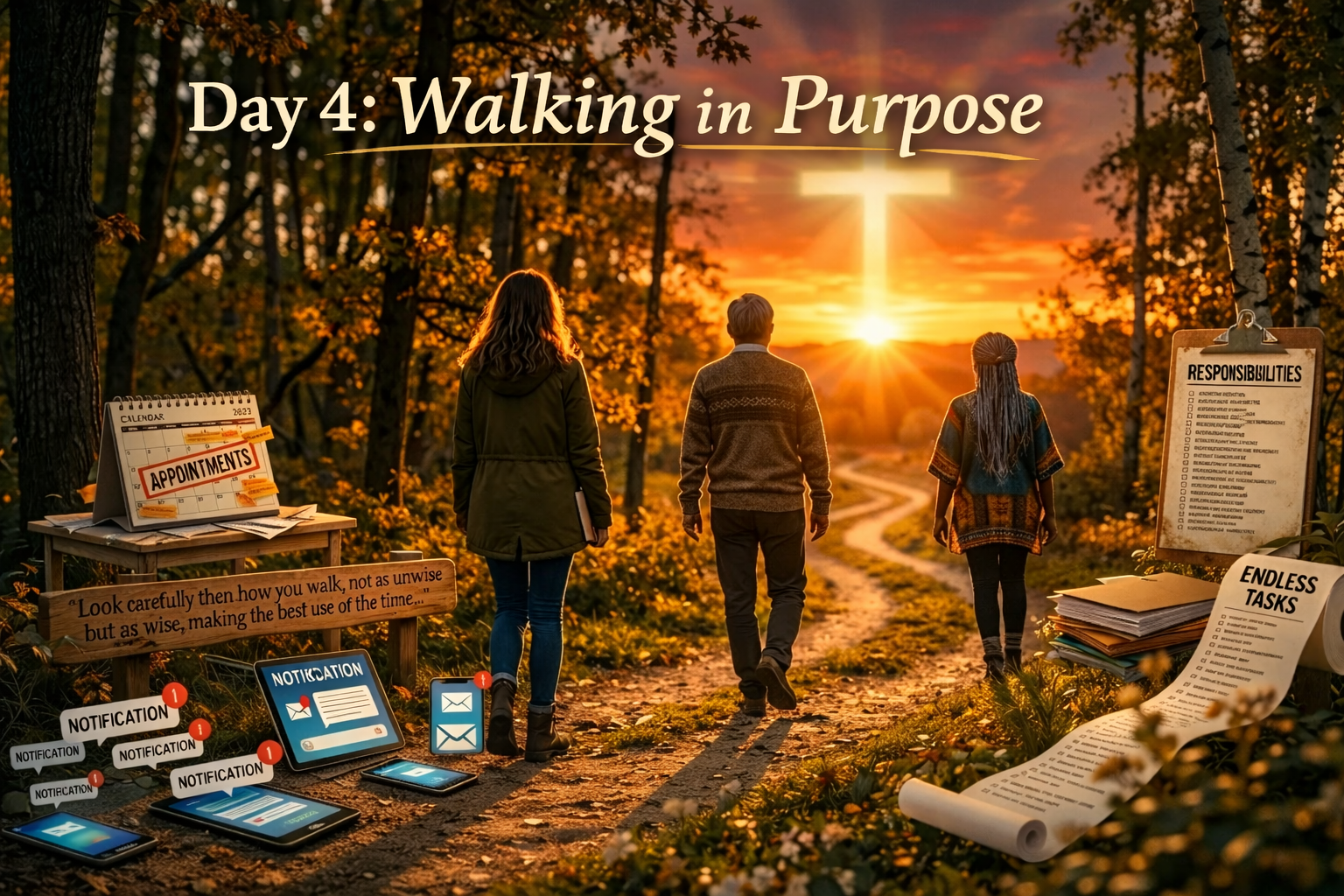
Day 4: Walking in Purpose
Are You Moving Forward — or Just Moving?
“Look carefully then how you walk, not as unwise but as wise, making the best use of the time.”
— Ephesians 5:15–16 (ESV)
Some days end with your whole body tired but your heart empty. You were busy from the moment you woke up. You checked messages, answered requests, handled things that felt urgent. You moved quickly from one task to the next. And still, somewhere around the time you finally sat down, a quiet frustration crept in — not because nothing got done, but because nothing that mattered got done.
Busyness can feel like progress. It has the look and feel of purpose — motion, energy, output. But there is a difference between a life that is full and a life that is going somewhere. You can run hard in a circle and still end up exactly where you started. That feeling of exhaustion without meaning? That is the warning sign Paul is pointing to in Ephesians.
The question worth pausing on is not “Did I do a lot today?” It is this: “Am I walking — or just wandering?”
God Has Always Been a God of Direction
Long before Paul wrote this letter, God made it clear that He does not simply exist — He moves with purpose, and He invites His people to move with Him. He led Israel through the wilderness with a pillar of cloud by day and fire by night. He gave Moses a mission. He spoke to the prophets with specific instruction. When Jesus walked this earth, not a single step was wasted. Every conversation, every healing, every meal had meaning connected to something bigger.
So when Paul tells believers in Ephesus to “look carefully” at how they walk, he is not giving them a personal productivity tip. He is calling them to live in step with a God who moves intentionally. The word “carefully” in the original Greek carries the idea of precision — of paying close attention to where your feet are landing. God is not asking you to be perfect. He is asking you to be present enough to walk with Him rather than wander away from Him.
The Drift Nobody Plans
Nobody decides to drift. It does not happen in one big moment — it happens in a hundred small ones. A morning without prayer becomes a week without it. A habit of scrolling through your phone for a few minutes becomes an hour you cannot account for. The drift is quiet, which is what makes it so dangerous. You do not feel yourself moving away from purpose. You just slowly realize one day that you are far from where you meant to be. Paul calls this walking “as unwise” — and wisdom, in the biblical sense, is not just intelligence. It is the ability to see what actually matters and choose it.
Paul’s Letter to a Distracted City
Ephesus was one of the most exciting cities in the ancient world. It was a major port city, a center of commerce, and home to the famous temple of Artemis — one of the seven wonders of the ancient world. If you lived in Ephesus, there was always something happening. The markets were loud, the culture was loud, and the pull toward entertainment, status, and distraction was constant.
Into this environment, Paul writes a letter that calls believers to something quieter and far more radical: intentional living. He had already spent years writing about the grace of God, the unity of the church, and spiritual armor. But here, near the end of Ephesians chapter five, he narrows in on something practical — your daily walk. Not your theology. Your walk.
“Look carefully then how you walk, not as unwise but as wise, making the best use of the time, because the days are evil.” — Ephesians 5:15–16 (ESV)
That last phrase — “because the days are evil” — is not meant to make you anxious. It is meant to make you alert. Paul is saying that the world around you will not naturally point you toward God’s purposes. Culture moves fast and loud, and if you are not deliberate about your direction, the current will carry you somewhere you never chose to go. Wisdom, then, is the quiet decision to stop and check your coordinates before you spend any more energy walking the wrong way.
Paul himself lived this out. His time in prison did not stop him from writing letters that would shape the church for centuries. His suffering did not make him aimless — it made him more focused. He had learned, as he wrote in Philippians, to be content in whatever state he was in. Contentment and purpose are connected. When you know what you are walking toward, the circumstances around you stop controlling your direction.
Pause & Reflect
Before moving forward, sit with these questions honestly. Take your time.
1. What do you notice about Paul’s choice of the word “carefully”? What does it suggest about how much attention purposeful living actually requires?
2. Think about the past week. Where did you feel most like yourself — most in line with who God made you to be? What was different about that moment compared to the moments that felt like drift?
3. What is one area of your daily routine that you have been avoiding looking at honestly? What would it cost you to trade that habit for five minutes of something that actually matters?
Walking It Out This Week
Walking wisely does not mean rewriting your entire schedule. It means introducing small, intentional checkpoints into the rhythm you already have. Think of it like a traveler who pauses to check a map — not because they are lost yet, but because they want to stay found.
Start the morning with a single question before you pick up your phone: “What would it look like for me to walk wisely today?” You do not need a long prayer or a perfectly quiet space. You just need thirty seconds of honest attention before the noise starts.
When you notice a moment of aimless drifting — scrolling without a reason, filling time without a purpose — treat it as a signal, not a failure. That moment is your reminder. Redirect it. Open a verse, send an encouraging message to someone who needs it, or simply sit still and ask God to show you what He wants from the next hour. Then, before you sleep, take two minutes to review the day. Not to grade yourself — but to notice. Where did you walk wisely? Where did you drift? What does tomorrow need?
Start today: find one drifting moment and replace it with five minutes of something purposeful. Prayer. Scripture. Encouragement. Learning. Small choices like that, made again and again, are how purpose becomes a pattern.
Prayer
Lord, I want to be honest with You — I have been moving, but I am not sure I have been walking with You. I have filled my days with things that felt necessary, and I ended up further from purpose than I meant to go. I do not want to keep drifting.
Teach me to walk carefully. Help me recognize distraction for what it is — not just wasted time, but a detour from the person You created me to become. Give me the courage to say yes to the things that matter and no to the things that only keep me busy.
I trust that You have a direction for my days. Guide my steps today. Help me use my time with the same kind of intention that Jesus did — connected, purposeful, and close to You.
In Jesus’ name. Amen.
Every intentional step — however small — is an act of faith that says God’s purpose for your life is worth protecting.